

When visiting the Powell-Cotton Museum, it’s hard to miss our stunning dioramas. They have been our most popular exhibits for over 120 years, and capture the fascination of children and adults, experts and laypersons, and new and repeat visitors alike. But what exactly is a diorama?
The term diorama originally described techniques borrowed from the theatre to create 3D effects and scenes when viewing paintings and other artwork.
In the mid-to-late 1800s, people started to realise that when combined with taxidermy (the mounting of animal skins), dioramas were a great way of replicating habitats and nature scenes, and the natural history diorama was born. Innovation happened in multiple countries, driven by a desire to show off trophies and educate those who could not travel.
Today, our dioramas are among the oldest in the world, and the Kashmir diorama in Gallery 2 is the oldest surviving large diorama in the UK.
A typical Natural History Diorama has 3 main elements:
The Background
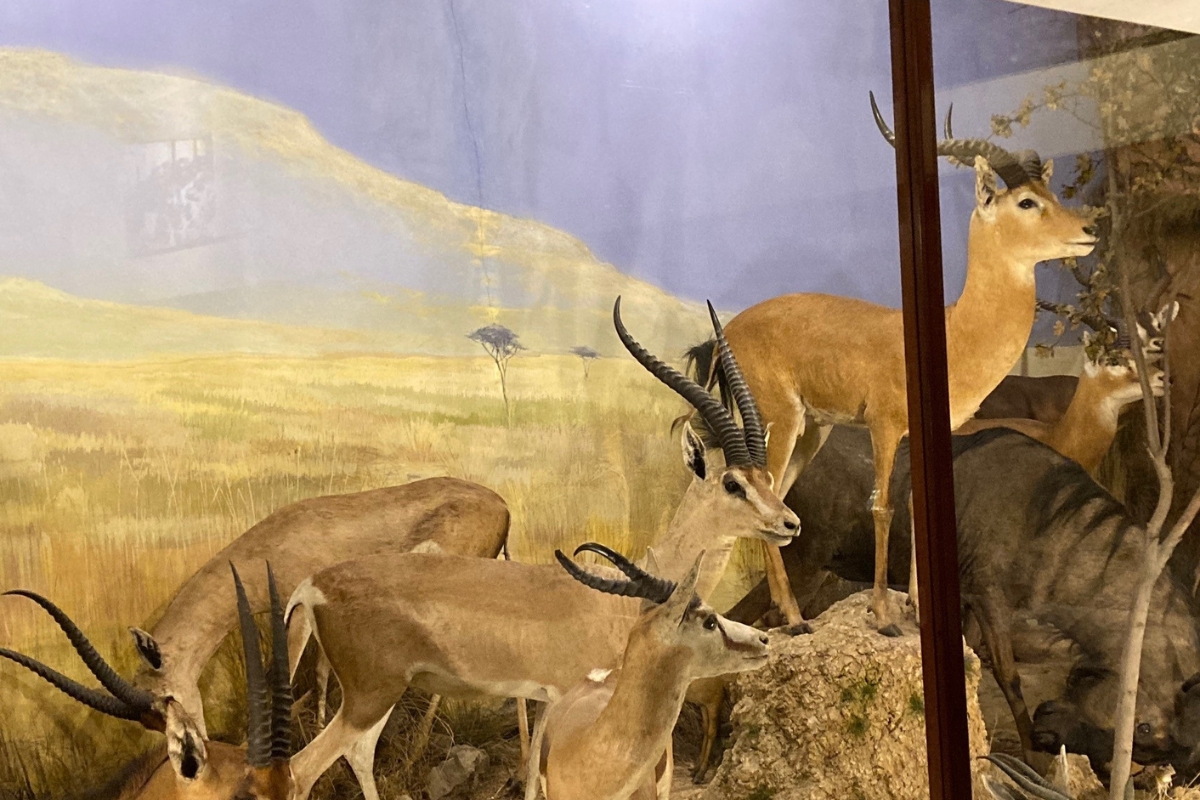
The painted background most closely resembles the original theatrical dioramas. It usually shows a habitat or landscape, although the scale can vary greatly. You might see a close-up of the shrubbery undergrowth of a forest, or the sprawling landscapes of savannahs or frozen tundra. The goal at any scale is to recreate a realistic perspective on a flat background, as if you were viewing a real-life scene.
Look closer
The backgrounds in our dioramas are mostly of the “sprawling landscape” type. They were based on black and white photographs and verbal description, making the artists’ work even more remarkable. In Galleries 1 and 3, you might be able to spot the respective artist’s signature in one of the dioramas.
The Modelled Foreground
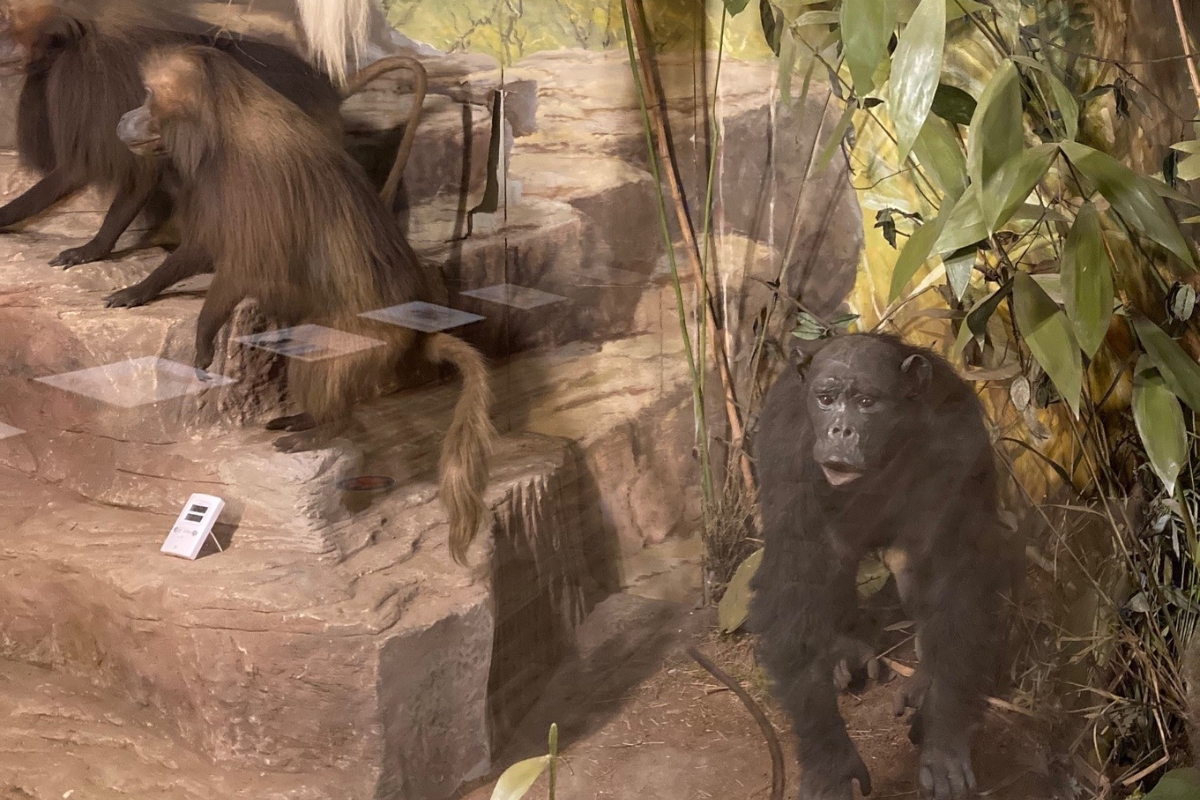
The foreground brings in the 3D elements that the early inventors were so keen to achieve. It often combines preserved plants such as tree trunks and dried grasses, with modelled elements ranging from individual leaves to all-encompassing rocky cliffs.
Painted glass or resin are a popular choice for creating water effects. When combined, the elements create a scene that blends seamlessly into the background. In our dioramas, smaller animals, especially insects, are treated more like foreground materials, adding to the set dressing rather than being a focal point.
Did you know?
The rockwork in many of our dioramas is built using old boxes and crates. It was a method of saving costs and re-using what was already there. On some boxes, you can even still see, what they were used for.
The Taxidermy Animals
It wouldn’t be a natural history diorama, without natural history specimens. The animals are intended to be the stars of the show, and to bring the entire scene to life. How many are used, depends heavily on the intention behind the diorama.
Some artists created almost photographic snapshots, with only a handful of animals interacting with each other and their environment in a single moment, frozen in time. Others, such as in our case, wanted to show the range of animals living in a habitat and variations between them, partially ignoring realism by placing animals much closer together than you would see them in real life.
Both types can teach you something about an animal and the space it lives in, and both are rightly admired for the artistry and dedication that went into creating them.
Create the
perfect day out
Whether you want to join a guided tour, explore the museum at your own pace, or just wander and see what you find, you can plan your day your way. Discover something new with each visit.
Create your perfect day out
Answer a few simple questions to plan your day out and get recommendations of things to see!
